




Connect your AI app to 300+ health platforms
Connect your AI to all health data sources with Terra's AI interface. We handle high volume, messy, raw health metrics across 300+ data sources in the most token efficient way.






What you need to know about health data for AI
Health platforms generate health data over long periods of time. Unlike typical AI inputs, these datasets are high-volume and require context to interpret correctly. To address this, Terra built infrastructure that transforms raw health data into structured representations optimized for AI reasoning.
Why can't you just send raw health data to AI?
Below are four challenges you need to consider when integrating health data into your AI product.
When we started building internal AI systems years ago, our biggest mistake was sending raw payloads from apps, sensors and wearables directly into AI models.
Health data is fundamentally different from text data because it's extremely high volume (daily data across years) and has high variability (e.g. HRV differs per person). It is also context-dependent. For example, the same HRV means different things depending on sleep, stress, history.
Here's what to consider:
- !
Context window explosion
A single user produces millions of data points per year. When raw time-series data is sent directly to an AI model, the prompt will exceed context limits. This is especially the case if you want to take 3 months+ data into account.
- !
A lot of signal, and a lot of noise
Unfiltered health data is noisy, full of duplicates and artefacts. Including unrelated data increases cognitive load for the model and leads to weaker or misleading conclusions.
- !
Token costs increase over time
Large prompts directly increase inference costs. Sending raw historical health data for every query quickly becomes expensive, especially for long-term analysis.
How Terra handles health data for AI the right way
To build successful AI products, you need to prepare numerical health data for semantic reasoning.
Traditional APIs were designed for completeness—they return all available data. However, AI systems need the opposite: they only need data that is meaningful for the current reasoning task, in a way that doesn't exceed their context window limits.
For this reason, we should not treat AI like a raw data processor. Large language models are optimized for reasoning over structured data rather than discovering patterns within raw numerical data.
This led us to develop a layered approach to preparing health data:
- ✓
Terra transforms data into an AI format
Terra converts raw health data into a canonical structure optimized for AI by unifying schemas, normalizing units, timestamps, removing duplicates and sampling intervals.
- ✓
Terra performs data aggregations to reduce tokens
Terra compresses health data into structured summaries that preserve meaningful patterns while reducing size via statistical aggregates, trend summaries, and event-based summaries.
- ✓
Terra keeps a health memory for each user
Terra maintains a structured health memory that evolves over time, so that AI can reason from accumulated understanding instead of raw history for lower costs and faster processing.
Terra's health data processing pipeline
for AI-ready context
Health data enters as heterogeneous time-series payloads from multiple health data sources such as bloods, wearables, medical devices, and health apps. Terra processes this data through a structured pipeline that converts raw measurements into consistent, token-efficient context optimized for AI reasoning.
How health data is prepared for AI
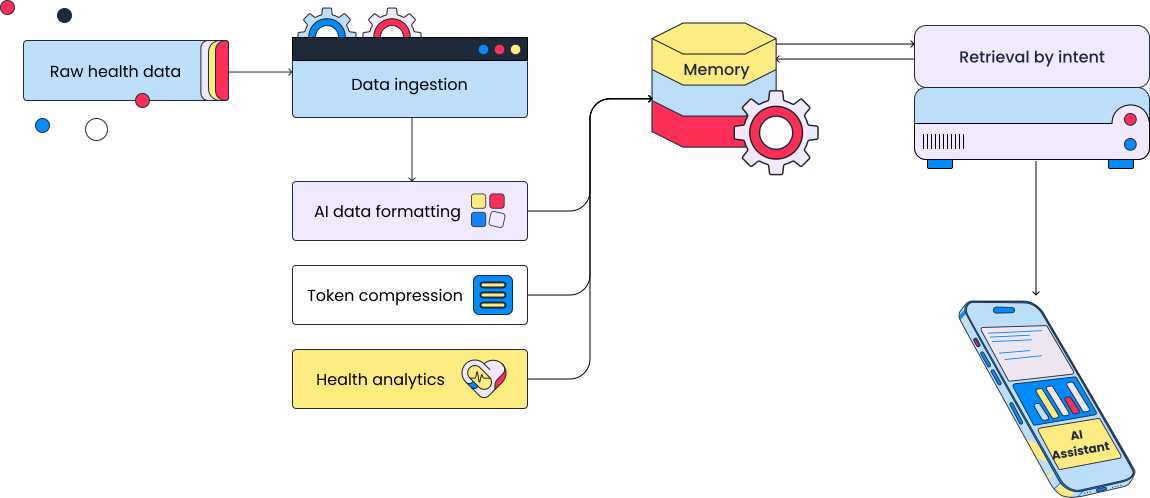
Terra processes raw health data through several steps that prepare it for AI systems.
Data ingestion
Collect, refresh, and backfill health data across 300+ data sources including clinical devices, wearables, blood reports, sensors and health apps. Terra manages user authentication, provider tokens, and high-volume metric streams including 5,000+ different health metrics.
- User authentication + consent flows
- Token lifecycle management
- Real-time freshness
- Historical backfill
AI data formatting
Transform data payloads across 300+ sources into a single canonical schema with consistent units, timestamps and identity rules. This step makes sure that there are no contradictions (units, timezones, duplicates, missingness) when AI reasons over your data. What normalization means:
- Schema unification
- Unit normalization
- Timestamp normalization
- Duplicate detection
Token compression
Compress and aggregate large volumes of raw health data to fit into your AI's context window. Health data queries such as 'How does my REM sleep last year compare to this year?' often span months or years. Our compression turns raw time-series data to AI-ready summaries.
- Statistical aggregates
- Summaries: Weekly and monthly HRV/HR/Sleep trends
- Frequency-based signals (% days below threshold)
- Trends: Rolling averages, slope direction
Data retrieval by AI intent
Instead of sending all available health data to AI every time, Terra first determines what health data is necessary. This makes AI faster, more accurate, and reduces token spent. Intent-based retrieval understands:
- Which health domains are relevant
- Which health metrics are required to answer a health question
- Appropriate time horizon and granularity of data
- Whether raw data, aggregates, or scores should be returned
Advanced analytics
Give your LLM access to physiological interpretations of raw health data. Our analytical processing pipeline converts raw measurements into science-backed health scores:
- Health scores: Sleep, recovery, strain
- Pattern detection: Weekday vs weekend differences
- Event-triggered analysis: Sleep after heavy workouts
- Baseline comparisons and deviation analysis
Health memory
Terra maintains a health memory for each user that summarizes and caches what is already known. This allows AI to build on prior understanding and avoids reprocessing large amounts of historical data. The result is faster responses and more accurate results over time.
- Physiological baselines like sleep duration, HRV ranges
- Known behavioral relationships
- Health scores and analytics
- User goals, preferences, and prior interactions
Impact on your AI health product
Terra turns continuous health data into tool-callable, AI-ready context so your AI can reason over your users' health questions with speed, safety, and trust.

Ship AI products with unlimited health data context
Terra provides the health data infrastructure for AI assistants, coaching apps, and personalized dashboards. Get structured health context your models can use immediately.
AI assistants
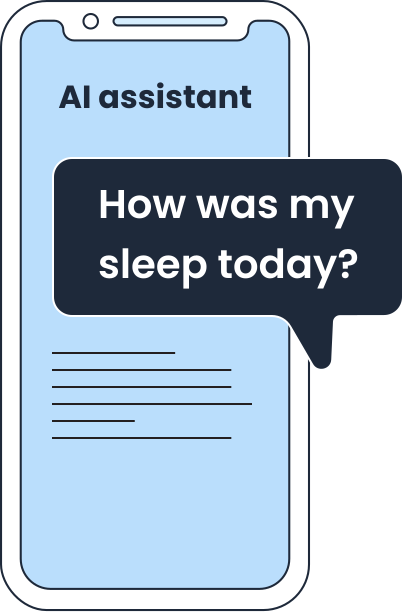
Answer complex health questions using structured physiological data from bloods, medical devices, wearables and apps.
What you are able to do
- Analyze multi-year sleep, activity, and recovery trends.
- Explain physiological patterns in plain language.
- Compare current health signals against personal baselines.
- Provide context-aware recommendations grounded in historical data.
How Terra API powers it
Terra converts heterogeneous wearable data into normalized, aggregated, and structured context, allowing AI models to reason over health signals without parsing raw time-series payloads.
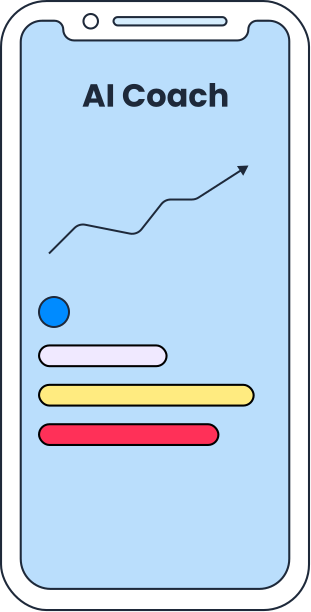
AI workout coach
Adjust training recommendations dynamically based on recovery, strain, and physiological readiness.
What you are able to do
- Modify workout intensity based on recovery metrics.
- Detect fatigue or insufficient recovery patterns.
- Recommend rest periods and training adjustments.
- Track performance trends relative to sleep and activity behavior.
How Terra API powers it
Terra aggregates and analyzes physiological data into structured health signals and derived scores, enabling AI to evaluate readiness without processing large volumes of raw sensor data.
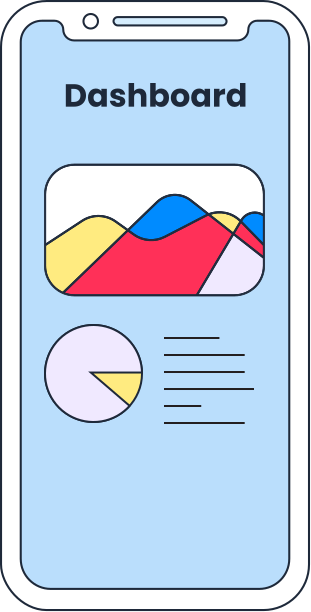
Personalized health dashboards
Generate meaningful health insights that update throughout the day.
What you are able to do
- Produce weekly or monthly summaries of health patterns.
- Highlight correlations between behaviors and outcomes.
- Detect meaningful trend changes automatically.
- Reduce information overload by filtering irrelevant signals.
How Terra API powers it
Terra compresses time-series health data into statistical aggregates and derived signals that AI models can interpret directly.
Built for agentic AI experiences
Unify
Deduplicates, resamples and prepares time-series user data for AI ingestion across 300+ health sourcesCompress
Turn months of user data into low-token reasoning bundles via aggregates, personal baselines and indexesRetrieve
Your AI retrieves exactly what it needs via MCP tool calls.AI applications built on Terra API
Teams across fitness, clinical care, wellness, nutrition, insurance, and corporate health use Terra to connect their products to labs, wearable and medical device data from over 300 sources.
- AI health assistants
- Metabolic AI apps
- Performance
- Corporate wellness
- Insurance programs
- Patient monitoring
- Preventative health
- Longevity programs
- Hypertension
- Movement programs
- and more…
- Consumer wellness
- Women’s health
- Period cycle tracking
- Nutrition
- Fitness coaching
- Sleep programs
- Mental health
- Team analytics
- Gym apps
- Recovery products
- Weight loss
- Precision health
- Health ecommerce
- Chronic conditions
- Heart health
- Population health
- Blood biomarkers
- Hormone tracking
- Stress management
- Lifestyle tracking
Is Terra API right for you?
We built Terra API so that you can get all the health data into your AI products without additional back end effort. These are all the additional benefits you get by working with us:
Integration time
Full data coverage
Canonical schema across all sources

Unit normalization
Historical data
Token lifecycle management
Data deduplication
Raw data samples
HIPAA, GDPR, SOC2 compliance
Context window optimization

Model Context Protocol (MCP)
Data aggregations and statistics
Device agnostic health scores
Health memory
Minimal data retrieval